Zara Can Change Its Mind. Most Fashion Brands Can't.
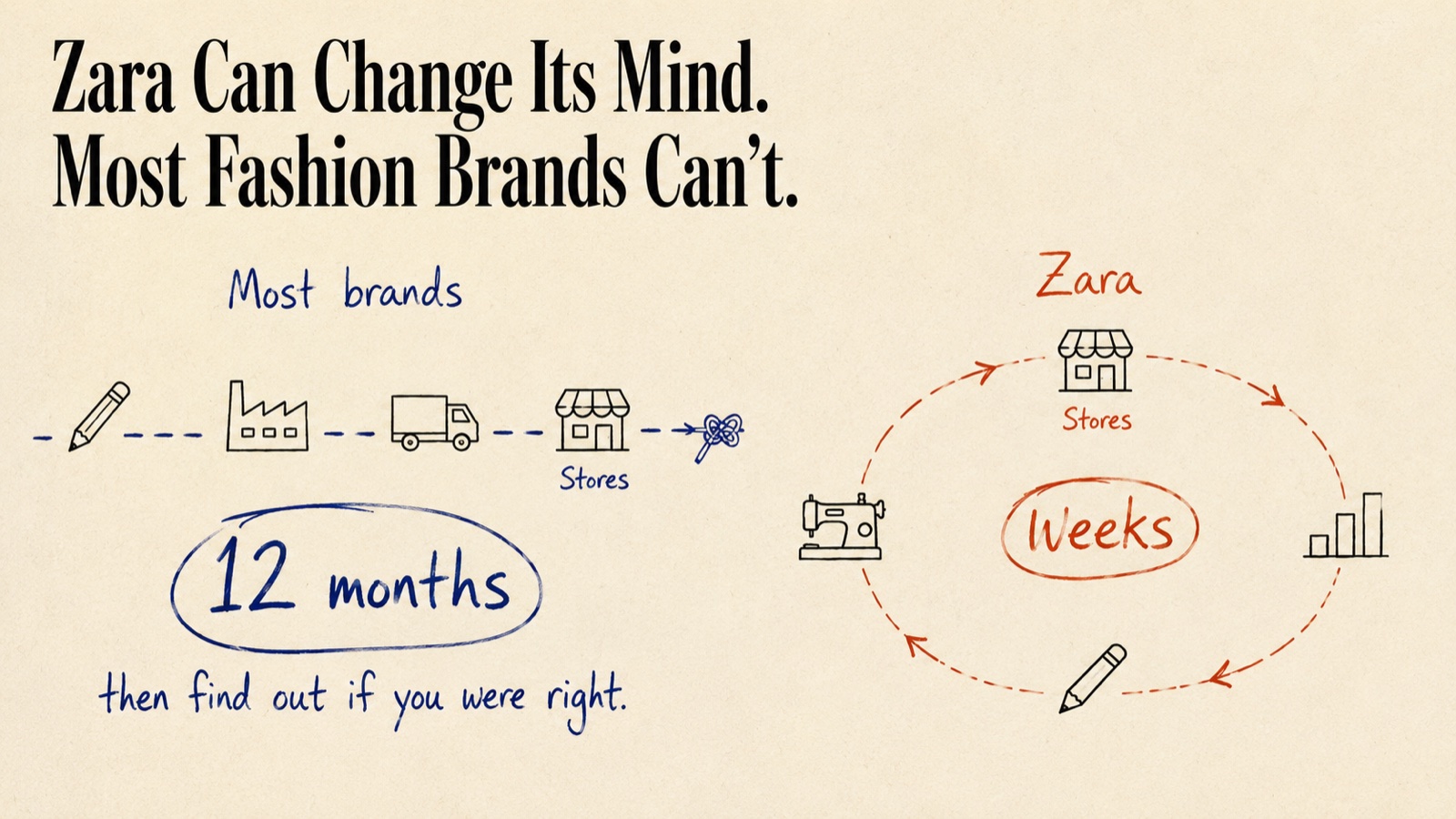
Most fashion brands decide what you will want next season before the season exists. Fabric gets committed, quantities get locked, and the whole plan rests on a forecast made six to twelve months earlier. Then the clothes land and the brand finds out whether it was right.
Two ways to run a season. One commits early and finds out later. One stays open and keeps deciding.
A system that holds the decision open
Zara built a system that holds the decision open.
The figures usually cited: Zara commits six months out to only fifteen to twenty-five percent of a season's line and locks in fifty to sixty percent by the time the season starts, which leaves up to half of what it sells to be designed and manufactured mid-season. By Zara's own estimate of its rivals in the same case work, most retailers instead commit forty to sixty percent of a season's inventory six months out and about eighty percent before the season opens.
One caveat worth stating plainly. Those numbers trace back to a Columbia Business School case study led by Nelson Fraiman that describes Zara's model in the 2000s, and they get recirculated constantly without a date attached, including a widely read write-up in Slate in 2012. Directionally they hold. Treat them as the shape of the model, not a current metric.
The proximity story is getting less true
Here is where the standard story gets it wrong. The usual explanation is geography. Zara produces close to Spain, so Zara is fast. That was true, and it is getting less true.
Inditex's 2025 annual report shows factories in the EU, non-EU Europe, and Africa accounting for 37.73 percent of its factories, a count of manufacturing sites and not a share of production volume, down nearly four points year over year, while more distant production in Asia and the Americas rose to 62.27 percent from 58.35 percent. The company still describes its model in terms of flexibility, responsiveness, and within-season proximity sourcing. Both are true at once.
The real advantage is information flow
Which points at the real answer. The advantage was never the map. It is that information moves fast enough to make a late decision safe.
Store-level sales signals reach the people deciding what gets made next, continuously, while there is still season left to act on. Capacity is held back rather than fully booked. Initial runs stay deliberately small, so being wrong is cheap and being right is repeatable. Every one of those is a decision about information flow, not about owning a building.
For a small brand, the loop breaks at memory
That distinction matters if you are a small brand, because you are never going to own a factory in Galicia. But the loop might be available to you anyway. The moves that make it work are not Zara's alone: keep the first run small, hold some capacity back, and reorder fast on whatever sells. A small brand can do all three.
Today it usually is not, and not for the reason you would expect. The blocker is not reaction speed. It is memory. The spec for last season's bestseller lives across a spreadsheet, a PDF, an email thread, and one person's head. When it sells out, the reorder is slow because the brand has to reconstruct what it made before it can make it again. The loop does not break at the reacting step. It breaks at the remembering step.
A brand cannot respond to what is selling if it cannot say precisely what it made. Get that part right and the loop opens up: when a piece sells out, the reorder starts from a complete record instead of a reconstruction, and you can answer demand while the season is still live. That is the unglamorous part, and it is where we start.
Common questions
Is Zara fast because it manufactures near Spain?
Proximity was part of the original story, and it is getting less true. Inditex's 2025 annual report shows most of its factory count is now in Asia and the Americas rather than Europe and Africa. The durable advantage is information flow: holding design and production decisions open until store sales signal what to make, rather than the map.
What can a small brand actually copy from Zara?
Not the factory network. The loop: keeping initial runs small, holding some capacity back, and reordering quickly on what sells. The usual blocker for a small brand is not reaction speed but memory, being able to say precisely what a bestseller was made of so it can be made again.
The loop starts with memory.
Silhouet keeps every product's full spec in one structured record, so when something sells out the reorder starts from what you actually made, not from scratch. Free to start during beta.